
Mastering the Socket Shield: ADA CERP Approved Training
Original price was: $360.00.$53.00Current price is: $53.00.
Socket Shield Technique – ADA CERP
 Download Now
Socket Shield Technique – ADA CERP
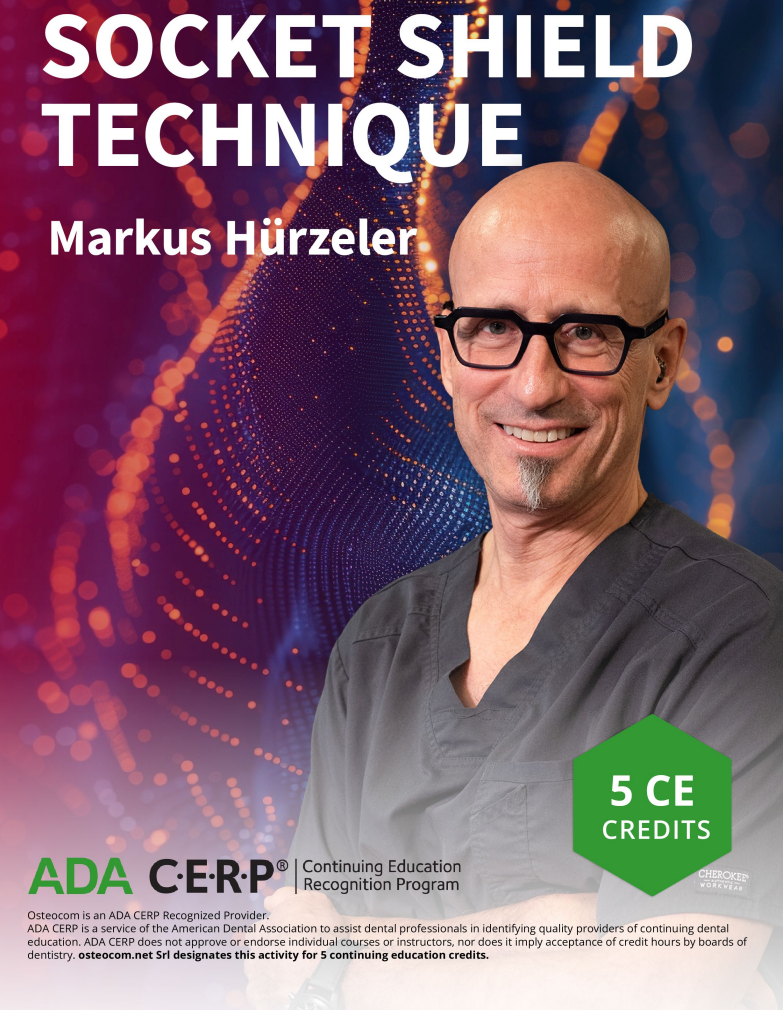
Dr. Markus Hürzeler welcome you to this comprehensive training experience on the biological rationale and surgical protocol of the Socket Shield Technique – the one-surgery approach that allows for immediate implant placement in the frontal esthetic area.
Achievable in one surgical session, the Socket Shield Technique ensures less invasiveness and morbidity, improved long-term stability, enhanced patient comfort, and excellent soft tissue outcomes that are comparable to – if not better than – those obtained with delayed implant placement.
Dr. Markus Hürzeler, the inventor of the Socket Shield technique, will guide you through the evolution of the surgical protocol, highlighting the refinements and innovations introduced over the past 15 years. Through several clinical cases, Dr. Hürzeler also replies to some of the most frequently asked questions concerning the technique, providing practical and applicable answers for your daily practice.
By joining this course, you will gain a deeper understanding of the biological rationale behind the Socket Shield Technique, the new classifications, the different stages of the treatment, and its practical application in different clinical scenarios.
Join Dr. Markus Hürzeler to uncover all the secrets of the Socket Shield Technique and meet the needs and expectations of even your most demanding patients!
The course includes:
- 5 video lessons with lots of clinical clips
- 1 final Socket Shield surgery
- The analysis of different clinical scenarios
Topics covered in the course:
- Socket Shield Technique: evolution, indications, and advantages
- The biological rationale and surgical protocol
- A new classification system and case selection strategy
- Immediate implant placement in post-extraction sockets
- Anchoring methods for shield stabilization
- Possible complications and how to manage them
- Clinical, radiographic, and volumetric evidence after long-term follow-up
At the end of the course, you will be able to:
- Offer your patients less invasive and time-consuming implant treatments
- Preserve soft and hard tissue volumes by maintaining the integrity of the socket
- Apply the new classification system to identify the ideal cases for beginners
- Design the shield and prepare the implant bed through the root using guided templates
- Maintain papilla height and gingival architecture to achieve optimal esthetic results
- Manage the gap between the implant and the shield to promote osseointegration
- Ensure improved long-term stability, soft tissue outcomes, and patient comfort
Be the first to review “Mastering the Socket Shield: ADA CERP Approved Training”
Related products

Reviews
There are no reviews yet.